Showing posts with label Louis Armstrong. Show all posts

Saturday, November 13, 2021

Crash Course Timeline, No. 28: The Hal Kemp Orchestra & The Trumpetist He Launched

Think both are in there....
I’ll be running into the biggest, bandiest names of the 1930s soon enough, but what started as a quick study into a bandleader whose name I kept seeing wound up detouring into the more interesting story of a member of not just his band, but just about every big band of the day. To start with the bandleader.

James “Hal” Kemp was born in 1904 in Marion, Alabama, but he made his name in Charlotte, North Carolina. A precocious kid, he formed his first band, the Merrymakers, while still in high school; by age 19 he led the Carolina Club Orchestra, a band associated with the University of North Carolina. The university showed a surprising willingness to let its band tour, even internationally, and Kemp’s Carolina Club Orchestra drew attention on its tour to England. The press passed on word of the tour and the orchestra had the honor of the Prince of Wales, Edward VIII (the one who later abdicated) sitting in for a session (he loved both jazz and American women).

A fair number of the guys Kemp played with in the Carolina Club Orchestra stuck with him for much his career. They included Ben Williams and Horace “Saxie” Dowell (one guess what the latter played, and they both played it), but also John Scott Trotter, a pianist who served as Kemp’s long-time musical arranger, and Edgar “Skinnay” Ellis, a drummer who became the voice of the Hal Kemp Orchestra when it took its successful, final shape. Per the Big Band Library, that line-up first came together in 1925 with Kemp doing the composing, co-arranging, playing clarinet and, his favorite, alto saxophone (sometimes “through an oversized megaphone with holes cut in the sides so his hands could work the keys”). That first line-up started playing standard 1920s jazz, but they switched over to the “sweet dance” jazz by 1930.

Sources describe Kemp’s sound with adjectives like “distinctive” (Wikipedia) and “intricate,” but Big Band Library wrote the more efficient paragraph on it:

“For decades afterwards, his fans and his former musicians continued to cherish the unique sound of Kemp’s band, with its muted, staccato trumpets (playing phrases, accented by four-note clusters of dotted 16ths - like a typewriter) and intricate clarinet and saxophone ensemble passages.”

When they broke in as professional performers, they started in New York. Rather than bang out the path of his career in my own words, I’m going to quote a long paragraph from a site called Oldies.com, because it gives a helpful impression of how careers in music looked in the early 1930s:

Thursday, October 14, 2021

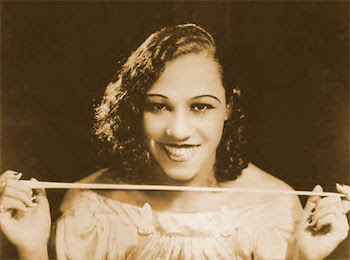
Crash Course Timeline, No. 26: Blanche Calloway, as Big as Her Brother's Shadow, Maybe Bigger

Damn legend.
As noted in the prior chapter on Cab Calloway, he grew up in the shadow of his older sister, Blanche Calloway. Pulling from multiple sources, first quoted from a website called Jazz Rhythm:

“Cab Calloway borrowed key elements from his elder sister’s act -- her bravura vocal style and Hi-de-Ho call and response routines. His 1976 memoir acknowledges her influence, declaring Blanche ‘vivacious, lovely, personality plus and a hell of a singer and dancer,’ an all-around entertainer who was ‘fabulous, happy and extroverted.’”

Now, from a site called The LeEMS Machine:

“She is relentlessly written about as residing in the shadow of her younger brother Cab Calloway. However, scholars and researchers have pointed out that, at one point, Blanche Calloway had attained more fame and renown, helping her brother in his show business breakthrough and inspiring his famous style.”

She would wind up living in Cab's shadow by the end of the 1930s, but, all things considered, Blanche Calloway arguably had the bigger life; it wouldn’t surprise me if neither one of them cared one way or the other. He borrowed from her style, she borrowed phrasing and characters from his songs (see cameos by Minnie the Moocher and the King of Sweden in Blanche Calloway’s hit, “Growlin’ Dan”), and so on. Both Calloways made their mark during the period when white audiences finally woke up to what black artists had been doing for decades. In this chapter, the “Hi De Ho Man” makes room for the woman who started her famous “Just a Crazy Song” with “Hi Hi Hi.”

Like her younger brother, Blanche Calloway was born in Rochester, New York, only five years earlier, in 1902. The family returned to their real home, Baltimore, Maryland, when Blanche was a teenager, with their mother, Martha Eulalia Reed, and her second husband, an insurance salesman named John Nelson Fortune.A church organist, Ms. Reed taught her children to play and love music, while trying to steer them away from careers in music, and she failed with at least three of them. In Blanche’s case, the betrayal came at the hands of a music teacher who pushed her to audition with a local talent scout. After Blanche dropped out of Morgan State College in the early 1920s, she wouldn’t hold another straight job until somewhere around the end of World War II.

Monday, September 6, 2021

Crash Course Timeline Music History Index: The 1920s, the 1930s & Early Popular Genres

The roots of this haphazard history of American popular music originally started about a year earlier and at least one music blog before this one. The former timeline started with the 1820s - when the United States as we (sort of) know it was just over 30 years old - and continued up to the 1920s. It introduced a multiplicity of themes and pathways, among them: the homesickness genre, a product of the Industrial Age and families scattered as wide as they’ve been in human history; the interaction between popular music and waves of immigration; the bloodthirsty/God-is-on-our-side anthems of America’s wars, both civil and others; the massive, popular, semi-utopian “Jubilee” concerts that followed; the noteworthy spasm of Christmas carols that bloomed alongside the commercialization of that holiday; the odd devotional number; marching bands and the arrival of modern brass instruments; the maudlin borderline hackery of the late Victorian era; the establishment and growth of Tin Pan Alley and its remarkable marketing machinery; and, perhaps more important than any of them in terms of what came later, minstrelsy. No less significant: literally all of that moved about the country by way of sheet music, the first conduit for the mass marketing of popular music.

All of that both informed and laid the foundation for much of what followed, but it also existed and operated in a vastly different and slower world. I think citizens of the 21st century can conceptualize, even appreciate those times, but actually wrapping one’s head around all that silence requires more imagination that most of us have. So, I took down those posts (twice, in fact) and restarted this follow-up project from a different foundation: the dawn of recorded sound, aka, the beginnings of a time when people could hear music without having friends who knew how to play it and, by the same devices, listen to a song until it either inspired them or made them puke.

Recordings existed well before the 1920s - singers ranging from John McCormack and Eddie Murray to the famous tenor Enrico Caruso (who recorded for one label's “high-class series”) - but I decided to start with the 1920s for several reasons. The ability to record sound came several decades before (by memory, the mid-1870s), but even 40 years later the sound remained limited - e.g., the recordings literally could not pick up pitches on the high end and some instruments all together - and, therefore, terrible. It took a decade or five for all the tinniness/recording-in-a-bucket-inside-a-box to the leech out, but recording and records (it’s all still 78 rpm at this point) reached the lofty heights of reasonable listening experience as early as the mid-1920s and continued to improve into the 1930s. Once film and radio arrived, they opened avenues for musical artists to spread their presence and influence across multiple mediums - i.e., the essence of modern stardom. That brings the story to the beginning of the modern era, at least in my mind. That said, keep in mind that the entire concept and culture of radio belongs to the 1930s - i.e., a time when the collapse of the consumer market made something one owns and turns on for entertainment the thriftier choice over something one buys and collects. As you’ll see if you read the posts below, a lot of them end with the Great Depression.

That gets ahead of the story, so, pulling back ten years, people call the 1920s the Jazz Age, but that does a real disservice to proliferation of genres that started and blossomed in jazz’s shadow. While none of them actually started in the 1920s, the way communications shrunk the world made once regional sounds available to a national audience - and one with resources to burn. That included the beginnings of country music - which, incidentally, came from the folk traditions of the 19th century - and at least three kinds of blues - e.g., 1) the female royalty of the early 20s, 2) the lone, often haunted blues men of the late 20s, and 3), at the tail-end, boogie-woogie. To back up even further, all of those borrowed something from ragtime - aka, the first “scary” (read: black) music to spook establishment white audiences - and Tin Pan Alley blended all that with popular sounds and themes from earlier eras, and that’s what the 1920s sounded like. Innovation meets mass-marketing, basically; strip away technologies that forever expand availability and accessibility and it’s not so different today.

Monday, August 23, 2021

Crash Course Timeline, No. 22: Louis Armstrong's "Hot" Sessions

The OG Hot Five.
I decided to see out the 1920s with a look at the early career of one of the biggest American musicians of the first half of the 20th century, Louis Armstrong. The content will bleed ever-so-slightly into the 1930s, but, unlike earlier posts on blues and country, the notes on jazz will end right around the same time the Jazz Age did.

Before digging in, I’ve got a frustration to acknowledge: the audio on Spotify’s early holdings for Armstrong is…well, just crap, muddy and barely audible to boot. That made it hard to hear the music I was hearing, which made it hard to appreciate the same. Basically, I don’t have the same sense/connection to the music that I typically do, which means the sampler will be a short, mildly pissy list of songs (or something else entirely). If Youtube doesn't have better audio, I apologize in advance. Also, the Internet didn’t have much on Armstrong’s early period, so this post relies heavily on Wikipedia. As much as I hate to mono-source, sometimes it's what you have.

Now…Louis Armstrong. I’m confident that a strong majority of people of a certain age can pick out his voice and I think those same people have clear sense of the music he played. Going the other way, the rest of it, especially his early years, would surprise most of those same people.

Born in New Orleans, in 1901, Louis Daniel Armstrong grew up hard, as indicated by the name of a neighborhood he came in and out of, The Battlefield. Both his mother and father came in and out of his life, and to the extent that he spent some years being raised by the Karnoffskys, a family of Lithuanian Jewish street peddlers. That short period of his life clearly meant something to Armstrong, who honored it by wearing a Star of David to the end of his life. He also gained fluency in Yiddish and his first experience with a musical instrument of any kind, e.g., the tin horn he played to attract people to the Karnoffskys wagon.

He was living with his mother again when he dropped out of school at age 11. The same year (or thereabouts) saw him get arrested for stealing his stepfathers’s gun and firing a blank into the air. The legal system shipped him to the “Colored Waif’s House” (aka, 1920s juvie) and into the care of a man named Captain Joseph Jones, a fan of all things military, including discipline. The upside of Jones’ love of the military was the presence of a marching band in the “waif’s house,” and that’s where Armstrong first found brass instruments. It also put him in front of the famous New Orleans trombonist, Kid Ory.

Sunday, August 15, 2021

Crash Course Timeline, No. 21: The (Paul) Whiteman Cometh

Paul Whiteman at the office.
Paul Whiteman led the most popular “jazz” orchestra for the duration of the 1920s, but the internet doesn’t have much to say about him or that. All of what’s below mainly relies on just two sources (Wikipedia and a piece for Syncopated Times), and most of the information between those two sources repeats. Call it historical revisionism, call it historical correction, the memory-hole has by and large swallowed Whiteman’s legacy. Still, his life and career open a revealing window into how popular music and the way people talk about it has evolved.

Some part of the that follows from a latter-day controversy over his promotional nickname as “the King of Jazz,” an appellation that doesn’t work on at least two levels. First, and on a purely stylistic level, Whiteman discouraged improvisation - aka, the “heart of jazz” - to the point of excluding it outright; his orchestras played carefully constructed arrangements instead, in which no one went off script. Second, and more significantly, he borrowed a musical form created by Black artists - a lot of them his contemporaries - polished it up and presented it to White audiences. To repeat a phrase I read over and over in the light research I did, Whiteman wanted to “make a lady out of jazz.” Or, to borrow from a couple places:

“While most jazz musicians and fans consider improvisation to be essential to the musical style, Whiteman thought the genre could be improved by orchestrating the best of it, with formal written arrangements.” (Wikipedia)

“But for the ‘King of Jazz’ title to be given to a white musician who never took a jazz solo instead of Louis Armstrong, Jelly Roll Morton, or any of a dozen other African-American jazz greats hurt Whiteman’s reputation despite his contributions to American music and the jazz age.” (Syncopated Times, 2020)

I appreciate that he had nothing to do with it, but the fact that his surname is “Whiteman” borders on Dickensian…

Tuesday, August 3, 2021

Crash Course Timeline, No. 20: Bix Beiderbecke, Davenport, Iowa's Hippest (Drunkest) Son

Why not go with the famous photo?
With an eye to future chapters, this post drags music back to the jazz of the 1920s - specifically to one of the genre's great innovators, Bix Beiderbecke. Even though he was born miles, and arguably worlds, away from the cities where jazz was born, Beiderbecke’s name moved in the same circles as the legends. That respect went both ways too, as noted on a Stanford University site called Riverwalk Jazz:

“Later, both Bix and Louis avowed that the other was ‘the best horn player he had ever heard.’”

I saw comparisons between Louis Armstrong and Bix Beiderbecke over and over as I dug into the latter’s legend - and it is a very much a legend. Some of those comparisons read differently today than the would have two, three decades ago. For example:

“Where Armstrong's playing was bravura, regularly optimistic, and openly emotional, Beiderbecke's contained a range of intellectual alternatives. Where Armstrong, at the head of an ensemble, played it hard, straight and true, Beiderbecke, like a shadow-boxer, invented his own way of phrasing 'around the lead.' Where Armstrong's superior strength delighted in the sheer power of what a cornet could produce, Beiderbecke's cool approach invited rather than commanded you to listen.”

Fans of American football should hear a faint echo from conversations about, say, wide receivers in that...

Leon Bismark “Bix” Beiderbecke was born into a well-to-do family in Davenport, Iowa in 1903; a lively, if pointless, dispute surrounds whether his middle name was actually Bismark or Bix, but he clearly preferred the latter and never went by anything else (as he signed off in a letter to his mother, written when he was 9-years-old, “frome your Leon Bix Beiderbecke not Bismark Remember”). His father trafficked in coal and lumber and his mother’s father was a steamboat pilot, but Beiderbecke must have fallen in love with music the second he heard it. His sister recalls him playing piano by age three - he played with his hands over his head - and, when the local press caught wind of him, they hailed him as a seven-year-old boy musical wonder,” and under headlines reading, “Little Bickie Beiderbecke plays any selection he hears.” He learned how to play a couple instruments, but he would latch onto the cornet and never let go.

Sunday, May 23, 2021

Crash Course Time Line, No. 13: The Blues, Blind Willie McTell & the Father of the Guitar Solo

Thank you, Lonnie Johnson.
Like country and jazz, the blues evolved into its modern form just before the 1920s. Rather than attempt a declarative, “the blues are _________,” I’ll just flag a couple key ideas and refer interested parties to Wikipedia’s entry on a great American genre. They go further back, for one, kicking around possible connections to “blue devils” seen by drunks in the grips of alcohol withdrawal (but…pink elephants?), or even a related phenomenon like blue laws banning the sale of alcohol, which would also keep those blue devils at bay.

The form of the blues relevant to this post evolved in southern Black communities, mostly after the American Civil War and during the decades after the abolition of slavery. In the same way that good and healthy things grow out of manure, the roots of the genre extended into the slavery era in musical forms like spirituals, work songs, field hollers and old ballads. A 1997 Georgia public television documentary on Blind Willie McTell, one of the subjects of this post, gives a short, but more compelling take on how communal music like work songs evolved into the classic blues format of a lone singer and his guitar. In that telling, Black Americans moving around in search of both livelihoods and lost family members often wound up as solitary farmers (often sharecroppers), and they held those same songs in their collective memory. The second part involved Sears catalogs ubiquitous across the American south, a lot of which sold guitars, a fairly new instrument at that time; the guitar eventually evolved into the “response” in the “call-and-response” structure of old work songs - i.e., the singer sings the lines (or the story) and the guitar "calls back" in an alternating pattern.

A whole bunch of threads cross here - e.g., country music (with the banjo borrowed from African Americans), music from the popular minstrel shows - but (riffing a bit here) blues seemed to develop within Black communities, i.e., in isolation from the other two. Minstrelsy, in particular, held onto the slave days. Black amateur musicians moved the genre forward playing “juke joints” and making the songs more lyrically complex - e.g., from repeating the same three lines to the AAB pattern (line, line, concluding line) - and richer and more varied musically, until, by the beginning of the 20th century, blues started to sound like a stripped-down version of the popular songs of the 1920s and 1930s.

A man named Hart Wand published the first blues composition in 1912, with “Dallas Blues”; the same year saw W. C. Handy publish “St. Louis Blues” and “Memphis Blues” - none of which will register as "blues" to a modern audience; the mash-up of blues and jazz quickly differentiated (while ragtime became parody before it died before the 1920s).  Conveniently, the place names of those titles map a loose boundary around where the genre took root and grew. For reference, Wikipedia had this to say about Handy’s work: “his compositions can be described as a fusion of blues with ragtime and jazz, a merger facilitated using the Cuban habanera rhythm that had long been a part of ragtime.” The blues took a detour in the early 1920s, when female singers - e.g., Lucille Bogan, Ma Rainey and Bessie Smith (both covered in this series) - dominated what was popularly called the blues. That was one version of what became known as “the Urban blues”; the one man and his guitar model formed the other branch. By the end of the 1920s, that became what comes to mind for most people when someone says, “the blues.”

Thursday, April 1, 2021

Crash Course Timeline, No. 9: OG Jass & a Few of Its Pioneers

What the hottest bands of the 1920s probably looked like...
I hadn’t planned on either doing a general post on 1920s jazz or touching on more half-forgotten names, but, when I learned that one of the first songs Bix Biederbecke learned by ear was the Original Dixieland Jass/Jazz Band’s “Tiger Rag,” the lack of context started to bug me. And so…

What is jazz, who started it and where? To tackle the first question, and contra Jelly Roll Morton claim that he invented it, no one really knows the answer. One can nail down some specific firsts - say, that Jelly Roll Morton wrote the first published jazz composition, or that the Original Dixieland Jazz Band (hereafter, “ODJB”) recorded the first 78 rpm album featuring jazz (“Livery Stable Blues,” b/w “Dixieland Jass Band One-Step,” Victor 18255) - but jazz, like the blues, had a long unwritten history that most people have the good sense not to fill in. In structure and theory, it has roots in blues and ragtime. Getting the a more useful answer, however, involves a couple twists and turns that still leave a handful of open questions.

“When Broadway picked it up, they called it 'J-A-Z-Z'. It wasn't called that. It was spelled 'J-A-S-S'. That was dirty, and if you knew what it was, you wouldn't say it in front of ladies.”
- Eubie Blake (quoted from Wikipedia’s overview, the main source for a lot of this)

Something forbidden, in other words, some new thing let loose in the wild of "real America." And yet the crowd went wild; in one of the oldest tales of American history, "real America" wanted jazz. The first ODJB 78 was sold as a novelty, only to surprise everyone by becoming a hit. Before too long, jazz and the people who played it came to dominate pop culture and ultimately become a big enough part in daily life that sense of the forbidden fall away. And, as often happens (which, here, means almost always), that didn't take long.

To return to the question of what jazz is, the Wikieditor had one theory on the origins of its name: it might have come from the slang term, “jasm,” which means “pep and energy” (...but when?). To flag some other, appealing theories:

“Jazz is characterized by swing and blue notes, complex chords, call and response vocals, polyrhythms and improvisation. Jazz has roots in West African cultural and musical expression, and in African-American music traditions.”

Monday, March 1, 2021

Crash Course Timeline, No. 6: Jimmie Rodgers, Tuberculosis & YOLO

Died at 36. Nuts.
By the time he turned 13, Jimmie Rodgers had twice tried to organize musical road shows, only to get retrieved by his father both times; he even got stranded with at least one of those. It’s not surprising, in other words, that Rodgers eventually worked as an entertainer. The real shock is how long he lasted working as a railroad brakeman.

Born in 1897, in either Meridian, Mississippi or Geiger, Alabama, Rodgers grew up in a large family that alternately fractured and diminished after his mother died when he was between six and seven years old. After some shuffling around, Rodgers moved back to Meridian to live with that same father, Aaron Rodgers (different Aaron Rodgers), who finished raising him and set him up with work on the New Orleans and Northeastern Railroad. The younger Rodgers started as a water boy, but later rose to the occupation of brakeman. Hence, his nom du career: The Singing Brakeman.

His Wikipedia entry talks about how Rodgers continued his musical education with help from railworkers and “hobos.” It also speculates that he picked up “work chants” by listening to the black employees of the rail-lines who maintained the railroads before machines took over - and he was certainly open-minded enough to do that. For a man with stars in his eyes, Rodgers stuck with his career on the railroad for a surprisingly long time. Famous people, even the eventually famous, get that final “nudge” from all kinds of places: in Jimmie Rodgers’ case, that nudge came with a tuberculosis diagnosis at age 27 (in 1924).

It wasn’t a clean break. He attempted another traveling show, only to see his tent destroyed by a cyclone; Rodgers returned to the railroad after that, relocating as far West as Arizona (on the theory that drier climes would help with the TB; he really did try) - but, by 1927, he returned once more to Meridian and finally and fully committed to a career in music.

It started with a free radio show with Charlotte, North Carolina’s WWNC. He recruited a band from Tennessee called the Tenneva Ramblers and, by the second half of 1927, he/they performed a weekly slot on the station - an unpaid gig, according to his Country Music Hall of Fame biography notes. The band performed as the Jimmie Rodgers Entertainers (hold that thought) and, per the bio posted on the Jimmie Rodgers Foundation, they didn’t sound like anything else on the local radio. It buzzed loudly enough for one area columnist to write: “Whoever that fellow is, he either is a winner or he is going to be.” Because the radio show didn’t pay, Rodgers and the Tenneva Ramblers played resorts to make some scratch.

Friday, February 5, 2021

Crash Course Timeline, No. 3: Bessie Smith, A "Rough," Brilliant, Damned Tragic Woman

The Empress of the Blues.
Tragedy bookended the life of 1920s blues legend, Bessie Smith. She lost her father, “a laborer and part-time Baptist preacher," before her memory kicked in and lost her mother (and an older brother) by the time she was 9 (or 10; I’ve read both). That threw her family onto the resources and guidance of her oldest sister, Viola, to raise what was left of a too-young family. The Smith family did some of the usual things to find income - e.g., doing other people’s laundry - but Bessie Smith and one of her remaining brothers (Clarence, I’m guessing) raised money by busking; they even had a street corner nailed down, Thirteenth and Elm Street, in front of Chattanooga, Tennessee’s White Elephant Saloon.

Clarence Smith later joined a touring troupe, one owned and operated by Moses Stokes, leaving Bessie behind and breaking up the busking team. He snuck out at night, knowing that Bessie would try to go with him. I haven’t read anything that says how she reacted to that whole thing, but, if hard feelings were present, Clarence made it up to her by finagling an audition to the same troupe for Bessie when she was 18 (old enough, basically, which was why Clarence snuck out the first time); that would have been 1912. She landed the job and joined her brother and the troupe on tour. The name of the company: The Rabbit Foot Minstrels - e.g., the same outfit that employed Ma Rainey. Rainey took Smith under her wing (there are rumors she kidnapped her, but…) and taught her how to sing the blues. Smith learned well. Very well:

“None of the others could sing with her combination of field holler and Jazz Age sophistication. None could throw her voice from the stage — without a microphone — and make a balcony seat feel like the front row. None made such an artistic impression on her contemporaries in jazz, or her disciples in rock 'n' roll.”

“Smith's version of ‘Downhearted Blues’ sold a reported 780,000 copies in 1923, a minor miracle for a song that had already hit nationwide for a variety of different artists.”

“In Smith's case, they amount to a woman whose life makes a liar out of every subsequent performer claiming to have had an original experience in the music business. She was the first bisexual, alcoholic, horsewhipped-by-segregationists, beat-out-of-songwriting-royalties, lemonade-making, dark-skinned singing-sensation whose husband cheated on her with a light-skinned ‘Becky with the good hair.’”

Thursday, January 28, 2021

Crash Course Timeline, No. 2: Ma Rainey, Her Black Bottom & More

Wanted a fresh angle. As a tribute to hers.
“Earlier, purely acoustic methods of recording had limited sensitivity and frequency range. Mid-frequency range notes could be recorded, but very low and very high frequencies could not. Instruments such as the violin were difficult to transfer to disc.”

While the limitations of acoustic recording are tangential to the immediate subject, discussions of music from the 1920s should start by admitting the obvious: the sound on the recordings is shit, poor enough to make already dated music sound almost foreign. Richard Crawford’s America’s Musical Life: A History goes into more and better detail on the instruments and vocal ranges that dissolved into aural mush (though not the abridged version; of which, I wouldn't buy it), but acoustic recording turned some sounds tinny while flattening out everything else. As such, as you listen to just about anything recorded during that decade, cut it at least some slack and understand you’re hearing none of these artists at their best, never mind as they were. That applies everyone, even Ma Rainey.

Gertude “Ma” Rainey (nee Pridgett) sits astride at least half a dozen cross-currents of popular music from the 1920s: she came up on the “minstrel” side of vaudeville; she recorded prolifically just as the phonograph outstripped sheet music as the primary vehicle for sharing music; she brought one of the earliest iterations of blues to white audiences and did it while collaborating with pioneers of another famous black genre, jazz; finally, she embodied “jazz age” lewdness, and proudly, singing songs that tore up a handful of taboos:

“In her songs, she and other black women sleep around for revenge, drink and party all night and generally live lives that ‘transgressed these ideas of white middle class female respectability.’”

This was during prohibition, mind, though I just read the other day that Prohibition only outlawed the manufacture and sale of alcohol, not the consumption of it…so one could drink. Even a black woman. Songs that heavily hinted at (and possibly referenced a 1925 “orgy” with members of her chorus), however, broke taboos that it took the world seven or eight decades to catch up to (the most infamous song was 1928’s “Prove It on Me,” which came very late in her career).