Showing posts with label American popular music. Show all posts

Wednesday, December 28, 2022

One Hit No More, Chapter 8: "Party Doll" Was the Life of the Party for Buddy Knox

Early branding issues (& Knox is 3rd from left.)
One of the more relatable bands in the sample, honestly. They sound like the ones I came up watching.

The Hit
If I’d ever heard Buddy Knox’s “Party Doll” before working on this chapter, it slipped my mind. Despite being something of a groundbreaking tune – which I’ll get to – it doesn't sound so different from everything else you hear from the early rock of the late 1950s. And yet it was a little risque for its time: the King of American Bandstand, Dick Clark, refused to pick up Knox’s single due to the signature line in its chorus: “I want to make love to you.”

That racy line surprises less once you know that Knox fronted the Rhythm Orchids, a band that became all the rage at West Texas State College. Despite getting inspiration to record from two straight-up legends - they hardly get bigger than Roy Orbison or Elvis Presley (Knox recalls Presley telling him after he met him after a show, “Man, if you've got a band and some good songs, get into a recording studio cause something is fixing to happen”) – the Rhythm Orchids didn’t have visions of fame dancing in their heads when they stepped into “the recording studio.” They cut the singles – “Party Doll” b/w “I’m Sticking With You” – to pass on as “souvenirs” for their fans at WTSC and beyond. They were lucky to get that:

“Norman was an electrician who had built his own studio. His echo chamber was in the top of his dad's garage with a speaker at one end and a microphone at the other. Every time a truck passed by, it sounded like it was in the studio with us.”

The “Norman” referred to above was Norman Petty. Anyone who knows that name is a couple steps ahead on one of the Points of Interest (see below).

In any case, Knox and his bandmates paid $60 bucks for three days’ worth of recording time at a studio that had no interest in operating as a professional outfit. The recording sessions ran from midnight to 6:00 a.m. so they wouldn’t have to share the microphones with those trucks. That flyer scored them a No. 1 hit that ultimately 15 million copies and went gold within its first year.

Not bad for a kid from Happy, Texas, who was surely the most famous of his high school graduating class of 26 kids.

Wednesday, December 14, 2022

One Hit No More, Chapter 6: Dale Hawkins, Swamp Boogie, and "Susie Q"

I see you.
If you thought Creedence Clearwater Revival’s “Susie Q” was an original, but never felt 100% sure about that, raise your hand.

The Hit
There’s definitely something sexy about it. The trance-like groove of the guitar figure, the blues-inspired lyric that borders on romantic mantra, the steady (unflagging) rhythm: put it all together and you get something damn close to a metaphor in musical form.

To stick with a persistent theme in this series’ early chapters, Dale Hawkins’ label (Checker Records) totally slept on his “Susie Q,” sitting on it for months before they released. Somewhere in the middle of stewing in his frustrations, Hawkins complained about it to a friendly DJ from Shreveport, Louisiana. The DJ rose to the occasion with a passive-aggressive masterpiece:

“Hawkins credits Shreveport disc-jockey Chuck Dunaway with helping Chess see the light. ‘I had sat there for three months waiting for 'em to put it out and [Dunaway] said, “Dale, let's just send it up to [Jerry] Wexler.” We sent a copy up to Atlantic and a few days later Jerry called and said, “I love it. I'll take it.” Then I explained to him, “Mr Wexler, Mr. Chess has got the thing and he hasn't released it. I had signed the papers with him.” He said, “What? You call him and tell him that he should either sh** or get off the pot.” “You want me to say it just like that?” He said, “That's all you got to say.” I called Mr. Chess and told him that. There was a little pause--and to hear Leonard pause during a conversation was something to talk about--and he said, “I'll call you back tomorrow.” Three days later, it was on the street. That's how fast it worked.’”

To their credit, Chess kept Hawkins’ single aloft once it took off by way of a “rolling marketing” strategy that involved pushing it in one market, and then moving on to the next one before that first market dried all the way up. While that stroke of genius didn’t come all the way off (Philistines), “Susie-Q” never became a monster hit. It topped the R&B charts – something that’s relevant to the larger story – but never went higher than No. 11 on the Pop charts and it didn’t stay long. And yet, it lingered in the musical culture for a couple decades...not unlike Dale Hawkins.

Thursday, December 8, 2022

One Hit No More, Chapter 4: "Be-Bop-a-Lula," aka, Gene Vincent's Happiest Moment

Yeah, no. Not even he could be drunk enough...
Some discrepancies betwixt the sources in this one. And some guns...

The Hit
I have a personal connection to Gene Vincent’s “Be-Bop-a-Lula”: my dad used to wake me for Sunday school with renditions of old rock ‘n’ roll songs, all of them flat as they were loud.

Vincent sang his signature song differently, obviously, with pinched, passionate phrasing that hinted at a man on the edge of ecstasy and a far from accidental dash of Elvis. The backing music – heavy on twang, surprisingly muted, but steady, steady, steady – lacks the sound and fury of some of the early rock records, and it turns out that’s the drummer, Dickie Harrell, screaming in the background because he wanted to prove to his mom that was him playing on the single.

Sources disagree how the song came together, but they all agree on where: in the U.S. Naval Hospital in Portsmouth, Virginia, where Vincent spent about half a year recovering from the motorcycle accident that shattered his leg (and almost saw it amputated). As for the how, a couple sources hold that a fellow patient named Don Graves wrote the words – with one source crediting a local stripper for the inspiration – while Vincent filled in the music. Other sources say Vincent bought the song, another says Vincent’s future manager, “Sheriff Tex” Davis, bought it while another has Davis claiming he wrote it with Vincent. Wikipedia’s entry on the song seconds a secondary theory in another source in saying that the inspiration came from the old Little Lulu comic strip, but that came from Vincent who admitted to rescuing that story from a blackout. Of which Vincent had many. So, let’s talk about how that happened...

The Rest of the Story, Briefly
He was born Vincent Eugene Craddock to Mary Louise and Ezekiah Jackson Craddock in Norfolk, Virginia in February of 1935, but his formative experiences happened in a small Virginia town called Munden Point. Vincent’s parents ran a general store in the town that did well enough that they could buy young Vincent a guitar. His first taste of music came from the old Grand Ole Opry mega broadcasts, but the move to Munden Point introduced him to black musical styles like gospel and blues. Once he had that guitar, he’d sit at the front of the store learning as he played; some of the locals egged him on by tossing out requests.

Vincent struggled in school, both socially (scrawny kid) and scholastically, leading him to drop out at age 17 to join the U.S. Navy (his dad signed the papers). He served during the Korean War, without seeing any action, but liked either Navy life enough, or the money, to re-enlist for another five-year hitch in 1955. Vincent traded his re-enlistment bonus for the Triumph motorcycle that would get nailed by a car (possibly driven by a drunk) and, more or less, destroy his leg. This is another place where sources disagree, but most of them agree he started wearing the “heavy metal brace” after this vehicular accident, as opposed to the later one. Something else that came with that brace: Vincent’s booze and pain pill habit.

Monday, December 5, 2022

One Hit No More, Chapter 3: The Chords (Literally) Go "Sh-Boom"!

A little who's who for ya.
My all-time favorite doo wop song. Hands down.

The Hit
“’Sh-Boom’ is supposed to have been titled after the threat of an atom bomb explosion which, in the midst of Cold War posturing in 1954, was a very real topic on the public's mind. However, this demented ditty also included the surreally optimistic message that everything was ultimately fine and as the rest of the lyrics suggested, ‘life could be a dream.’”
- Allmusic.com

I wish this was true with all my heart. But...

“It had nothing to do with the A-Bomb particularly. It was just a thing that happened to happen.... Jimmy was a great one for telling stories and he may have embellished it in that direction.”
- Buddy McRae (the once last-living Chord, New York Daily News)

Choose your universe, people...

Much like what happened with The Penguins and “Earth Angel,” the Chords came to their label with an original song called “Sh-Boom” and the label couldn’t give less of a shit about it. What excited them? A cover of the Patti Page tune, “Cross Over the Bridge.” The similarities don’t stop with the label guessing wrong – e.g., the same DJ (LA’s Dick “Huggy Boy” Hugg) flipped over the 45 and found the hit, the crossover from R&B to the Pop charts, the goddamn Crew Cuts cashing in on another act’s single – and they kept going in the big picture (e.g., singing second banana to another group their manager liked/valued more). The doo wop craze had a real gold-rush quality to it, at least in the first (mostly Black) wave.

The single itself is all energy, bright and irrepressible – and the return to the regular vocals after a bass-led bridge, in particular, really stands up that line in Allmusic.com’s history about a “demented ditty [that] also included the surreally optimistic message hat everything was ultimately fine.” Which isn’t bad for a single written by a bunch of kids in a ’54 Buick convertible. The public ate it up after its July 3, 1954 release, lifting it to No. 2 on the R&B charts (The Drifters’ “Honey Love” kept it out) and keeping it up there for 15 weeks. It climbed as high as No. 5 on the Pop charts, the first Top 10 hit by an R&B act since Louis Jordan’s (profiled here) long-time domination of over the 1940s.

Thursday, December 1, 2022

One Hit No More, Chapter 2: The Penguins Dancing with an Earth Angel

You're motoring/what's your price for flight?
Always liked this tune. Sounds like a slow-jam embrace feels...

The Hit
“’Earth Angel’ -- like so many '50s doo-wop ballads -- was structured on the chord changes of Rodgers & Hart's ‘Blue Moon,’ in a progression commonly known as ‘ice cream changes’ or ‘Blue Moon changes.’ Because so many '50s ballads use the same structure, oldies groups can string together seamless medleys of doo-wop classics.”
- Honolulu Star Bulletin featured, September 14, 2001

That takes care of the structure, now the story. As with The Crows’ “Gee,” the Penguins’ “Earth Angel” wasn’t the A-side of its 45. That was “Hey Senorita” (better song, for me) and their label pushed that one, only to have radio DJs flip the 45 and find the song that became the hit. It never reached No. 1 – their version only climbed to No. 9 on the pop charts (hold that thought) – but, by way of some creative math, Songfacts.com dubbed “Earth Angel” the “top R&B record of all time in terms of continuous popularity.” [Ed. – They arrived there by counting every version of the song (there are many), which yielded a total of 30 million copies sold.]

Personally, it takes me back to big dances that happened twenty years before I was born, scenes stolen from high school dances from movies and TV shows set in the 1950s. And the intimacy of the song – the slow, swaying rhythm, perfect for the side-shuffling clutch of teenage slow dancing, the lead vocals that float over it, as if lifted by the backing harmonies – has a way of making a pair of doting lovers feel like the only people in the world, even in a crowded room. A nice song, in other words, but one that kicked off one hell of a legal tussle.

Legal battles over the publishing and authorship rights to the song kicked off in April of 1955, about six months after it came out. As with a lot of civil suits, it didn’t have to happen and at least one of the wrong people won. Worse, it was just one piece in a larger falling out.

The Rest of the Story, Briefly
The Penguins started late in 1953, when two recent graduates from Los Angeles’ Fremont High School, Cleveland Duncan and Curtis Williams, bumped into one another at a California Club talent show. Williams was in a group called the Hollywood Flames at the time (who come up again in the soon-to-be renumbered chapter in this series on Bobby Day), but still struggling to figure out where he fit in (the rest of the band called him “too independent”). He had been working on “Earth Angel” with another member, Gaynel Hodge, under the tutelage of an up-and-coming songwriter named Jesse Belvin. According to everything I read for this chapter, that kind of collaboration happened all the time in this scene – i.e., people trading ideas, doing a little borrowing, etc. After the show, Williams pitched the song to Duncan, telling him his voice fit it. Duncan caught the pitch and went with it, all the way down to rewriting the melody.

Sunday, November 27, 2022

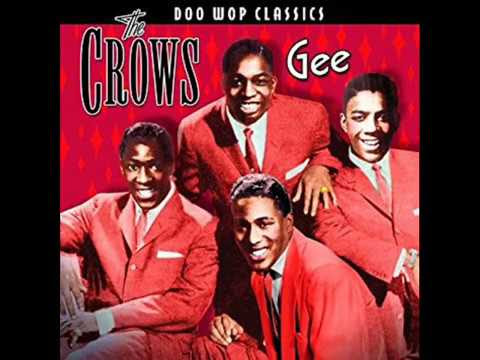
One Hit No More, Chapter 1: The Short Flight of The Crows, aka, "Gee"

Not pictured: Mark Jackson. Still.
There was no other Volume 1 to this series. Shhhhh...shhhh...shhhh....

The Hit
The Crows’ “Gee” took a while to find its legs. Their label and the radio pushed the A-side of the 45, “I Love You So,” for several months while “Gee” bumped a long in its modest shadow. The group recorded both in the same June 1953 session and that single counts as The Crows’ first run at the nation’s airwaves. They arrived at the beginning of doo wop’s second wave and both could have easily got lost in the noise of all the bird-themed quartets and quintets, but fate stepped in:

"It looks like ‘Huggy Boy’ was the cause. Dick Hugg was one of the DJs who broadcast from the front window of John Dolphin's record store in Los Angeles. He had played 'Gee,' months before, and decided he didn't like it much. The disc ended up with his girlfriend, who really loved it. One night they got into a fight and, to make up, Huggy Boy played the song over and over on the air for her. For some reason, that episode triggered an explosion of sales in LA. Kids who were lukewarm to the song when they heard it once in a while, went nuts for it when it was played non-stop.”

“Gee” may sound like an unremarkable pop/doo wop single, but it still caught the doo wop revival, even after the six-month delay. More significantly, some (e.g., Wikipedia) recognize it as the first rock ‘n’ roll hit by a rock and roll group. It also crossed over into the pop charts (it climbed to No. 14) at a time when distributor pipelines did not. One source (Marv Goldberg’s R&B Notebook) floated the plausible theory that white kids heard “Gee” on the radio and pestered their neighborhood record store owners until they ordered it.

On the musical side, the accompaniment is there, no question – you hear the double bass, the simple rhythm of the piano line, and the gentle shuffle beat of the drum, a reedy, jazzy guitar solo that sounds like the times – but the vocals and harmonizing do the bulk of the lifting, all the way down to the “doop-do-de-doop-do-de-doop-do-de-do-do-de-doop” (or something like that).

The Rest of the Story, Briefly
“Our story begins around 1951, in Harlem (on 142nd Street, to be exact), at a time when R&B vocal groups seemed to be springing up on every street corner, alleyway, and subway station in the city.”

Wednesday, October 19, 2022

One Hit No More, No. 118: Dazz Band Means "Danceable Jazz"

Exhibit A.
I would never have guessed where this band came fro - and I couldn’t have connected them to their hit with a gun to my head.

The Hit
“Harris realized quickly that ‘Let it Whip’ was special — ‘It’s a fun song and easy to sing, so people can sing it’ — and chasing the brass ring at the same level would be futile.”

The “Harris” in that quote refers to Bobby Harris, the founder of a succession of jazz, jazz-fusion, and, by that time, funk/R&B bands that hailed from Cleveland, Ohio. Big as it blew up – it topped Billboard’s “Hot Soul/Black Singles” charts, came within one spot on the “Dance Club Play” charts, and hit No. 5 on Billboard’s Hot 100 - I didn’t stumble into any great stories about the making or inspiration behind “Let It Whip.” That’s less surprising when you know Harris’ back-story, but still.

When I just think of the song, all my mind’s ear hears is a monotonous electronic drum, that squiggling bass and some pulsing synths, but “Let It Whip” holds up nicely in a closer listen – and how the hell does my brain hiccup over that guitar? – but the vocal fills/harmonic melodies are what tickle my ears just so...

...not bad for a songwriter who only never really thought of R&B/funk until he learned he could make a decent pile performing it.

The Rest of the Story
“’It was like cooking biscuits from scratch and I cook biscuits from scratch,’ he said. ‘It’s an old-school formula. You grow organically and don’t try to force a square peg in a round hole.’”

“’We never did stop performing,’ Harris said, laughing that he avoided ‘sitting on a corner with a tin cup in hand.’”

I didn’t find many killer quotables for Dazz Band, but those two do what I know of them justice. Charming as I found the long-form interview with Harris (linked to below with the rest of the sources), they lean far harder into the working band mold than they do something visionary. I don’t mean that as a knock. They formed back in 1976, if with a different name, and just kept on putting out music and performing from there.

Wednesday, October 12, 2022

Crash Course Timeline No. 54: Louis Jordan, Jukeboxes and Jump Blues

Speaks to the energy....
I’d heard a Louis Jordan something like 40 years before I ever knew his name. God bless Tom & Jerry...

He was born in the tiny town, Brinkley, Arkansas in 1908, but Louis Jordan became King of the Jukebox at his very impressive peak. Jordan also rates as one of the transitional figures in 20th- century popular music:

“Jordan began his career in big-band swing jazz in the 1930s, but he became known as an innovative popularizer of jump blues, a swinging, up-tempo, dance-oriented hybrid of jazz, blues and boogie-woogie. Typically performed by smaller bands consisting of five or six players, jump music featured shouted, highly syncopated vocals and earthy, comedic lyrics on contemporary urban themes. It strongly emphasized the rhythm section of piano, bass and drums; after the mid-1940s, this mix was often augmented by electric guitar. Jordan's band also pioneered the use of the electronic organ.”

His father, James Aaron Jordan, started him on both the clarinet and what would become his signature instrument, the alto sax. When the elder Jordan wasn’t teaching, he organized and coached the community band, the Brinkley Brass Band. By the 1920s – the year’s indistinct here; you get everything from 1920 (Blackpast.org) to the late 1920s (Wikipedia) – the younger Jordan’s talent earned him a spot in Ma and Pa Rainey’s touring company, the Rabbit Foot Minstrels. The general fuzziness of Louis Jordan’s younger years continued (online at least), but they generally agree that he wound up in Philadelphia for some time in the early 1930s, and either with or without his entire family, before moving to New York around 1936, where he split time singing in front of Chick Webb’s legendary orchestra (profiled here) with Ella Fitzgerald. I saw stray notes here and there about Jordan getting typecast as a comedic foil during his time with Webb, but that period wrapped up fairly quickly. By 1938, Jordan poured his considerable talents into a band of his own.

The original line-up of Louis Jordan’s Tympany Five featured nine players, but by the time they started their residency at Harlem’s Elks Rendezvous Club the line-up had shrunk to six members - Jordan on sax and lead vocals, Courtney Williams on trumpet, Lem Johnson played tenor sax, Clarence Johnson the piano, while Charlie Drayton laid down boogie-woogie bass lines and Walter Martin laid down the shuffle rhythm on the drums. Unlike the big bands, which often featured nearly 20 players and sometimes bloated to over 30, leading a smaller set up made Jordan’s band more affordable, while also letting each member earn more. And that both prefigured the standard rock ‘n’ roll lineup and changed the business:

Monday, September 26, 2022

Crash Course No. 40: Feeling the Cramps

The literal beating heart of the band.
The Very Basics
The Cramps started when Erick Lee Purkhiser (aka, Lux Interior) met Kristy Marlana Wallace (aka, Poison Ivy Rorschach) at Sacramento University in a class called Art and Shamanism. They bonded over collecting in general, records in particular. They started a pilgrimage east from there, stopping first in Akron, Ohio (1973), then New York City (1975), where they became a staple of the scene around CBGBs and Max’s Kansas City; after they played their first show, Lux Interior offered this bon mot: “Gee, we could do this again.” When they nailed down an original line-up, it featured Bryan Gregory on guitar and Pam Balam on drums, but twisted knot at the heart of the Cramps would forever and always be Lux Interior on vocals/front-man presence and Poison Ivy commanding lead guitar. Nick Knox (drums) deserves honorable mention as the longest-serving member of the band, lasting from 1977 to 1991. After several years in New York, the band returned to the West Coast and based themselves in Los Angeles.

Their debut EP, Gravest Hits (1979) buzzed big enough that Big Star’s Alex Chilton produced their debut album, 1980s, Songs the Lord Taught Us. The then-fledgling I.R.S. Records released it, but the Cramps chafed at the lack of creative control from the off and the relationship quickly soured. After 1981’s Psychedelic Jungle dropped, I.R.S. blocked them from releasing any new material until 1983’s live album Smell of Female. There's no real telling how much that hurt the band in the States , but they always did better in the UK, where they had their first hit singles - e.g., “Can Your Pussy Do the Dog” and, their one and only UK Top 40 single, “Bikini Girls with Machine Guns” – and where Stay Sick! (1990) charted at No. 62; meanwhile, back in the States, they couldn’t even find distribution for 1986’s A Date with Elvis until 1990. The rest of their discography, includes studio albums Look Mom No Head! (1991), Flamejob (1994), Big Beat from Badsville (1997) and Fiends of Dope Island (2003), plus the compilations Off the Bone (1983, released illegally, apparently) and, most famously (or this was the first one I heard), Bad Music for Bad People.

While critics have classified under a grab-bag of genres (e.g., psychobilly, gothabilly, garage punk, rockabilly, garage rock, horror punk, neo-rockabilly, punk rock and surf), the Cramps dubbed it “rockabilly voodoo” on their early promotional flyers. They claimed various influences, everything from early rockabilly (e.g., Jerry Lott, aka, The Phantom), “rhythm and blues, and rock and roll like Link Wray (both big fans) and Hasil Adkins,” 60s surf acts, 60s garage like The Standells, the Trashmen, the Green Fuz and the Sonics, The Ramones on the punk side, Screamin’ Jay Hawkins and, believe it or not, Ricky Nelson. A quote from Wikipedia about A Date with Elvis speaks to their aesthetic arc:

“The album featured what was to become a predominating theme of their work from here on: a move away from the B-movie horror focus to an increased emphasis on sexual double entendre.”

Tuesday, September 20, 2022

One Hit No More, No. 116: Marshall Crenshaw, The Motor City Mellow Dude

This one felt most right...
To think it all started with Beatlemania...which left the artist feeling conflicted...

The Hit
Marshall Crenshaw wrote “Someday, Someway” in only 30 minutes and it only strayed into “hit” territory (it topped out at No. 36), but it’s still a cool little tune by a largely forgotten singer/songwriter. He built it around Gene Vincent’s “Lotta Lovin’” (loosely), but made it his own:

“Crenshaw wanted to use the beat to create a hypnotic effect and wrote a new melody around it. The lyrics were described by Crenshaw as simple, but with a hidden depth; he later claimed that the lyrics had been influenced by the beginnings of his marriage.”

You’ll hear that slightly-fuzzed, reverb style guitar all over Crenshaw’s considerable catalog, but there’s definitely a better version of the single knocking around – e.g., The 9 Volt Years collection version. The studio version from his debut album is still a fine song...but, Lord, the crunch on that guitar on that 9 Volt version. Simple isn’t always better, but it sure as hell can be.

I remember seeing Crenshaw’s video on early MTV growing up, but only appreciate now just how far it went over my head. It’s a love song about the rarest subject of the form: the actual work of a relationship, as opposed to the fun shit of infatuation.

The Rest of the Story
“Although he was seen as a latter-day Buddy Holly at the outset, he soon proved too talented and original to be anyone but himself.”
- Trouser Press (quoted in Wikipedia)

Crenshaw was born in the Detroit, Michigan suburb of Berkley in 1953. There isn’t much about his childhood on the web, but he did mention how every high school seemed to have five or six bands. He formed his first band at age 15 – and it may or may not have been named “Astigfa” – an acronym for “A splendid time is guaranteed for all” borrowed from The Beatles’ “For the Benefit of Mr. Kite,” but the records show he played in that one. In any case, they played yard parties around the area before they could play the bars, and they played the bars after that. That carried Crenshaw to his early 20s, when he decided he wanted more.

Sunday, September 18, 2022

Crash Course Timeline, No. 53: Hank "Herky" "Skeets" Williams, Country's OG Rock Star

I like this one. Captures the fuss.
“Hank Williams’s legend now overshadows the rather frail and painfully introverted man who spawned it. Born Hiram Williams, the ‘Hillbilly Shakespeare’ came from a rural background.”
- Country Music Hall of Fame Bio

The Basics
The Country Music’s Hall of Fame doesn’t have much to back up that framing, but Hank Williams did squeeze a lot of hits and a lot of trouble into a short life. He was born Hiram Williams in 1923 in a suburb of Birmingham, Alabama, called Mount Olive. He was also born with spina bifida occulta, a cosmic accident that shaped his life from cradle to grave, but had more consequences on the back end.

His father, Elonzo Huble “Lon” Williams, supported the family with work on lumber company railways, but he disappeared from Hank’s life at a young age. Lon Williams fell off a truck while serving in World War I and those injuries lingered until 1930, when he started developing facial paralysis brought on by an aneurysm. He spent more than eight years in the hospital – the balance of Hank’s childhood – which left his mother, Jessie Lillybelle “Lillie” Williams to raise the family. She proved more than up for the task, working multiple jobs (during the Depression to boot) and ran a succession of boarding houses - even after the first one burned down.

Lillie also encouraged Williams’ love of music. The story of how he got hold of his first guitar varies – one version has him selling peanuts to buy it, another has people from all over whichever town he lived in at the time (they moved around a bit) claiming they bought it for him – but the man who taught him to play it was a busker named Rufus “Tee-Tot” Payne. Lillie paid Payne when she could for Hank's music lessons and fed him when she couldn’t, but he taught Williams the basics and on a blues-based foundation. Later, Williams would call Payne “my only real teacher.”

Circumstances – in this case a fight with a phys. ed. teacher – planted the family in Montgomery, Alabama, which is where his musical career starts. In 1937, Williams entered and won a talent contest at the Empire Theater playing a song of his own composition, “WPA Blues.” That earned him $15, but also an angle to sell himself to the local radio station, WFSA, when they saw him busking in front of their building on weekends and after school. The station’s producers handed him the equivalent of a part-time job ($15/week), but it started him on his way.

Saturday, September 3, 2022

Crash Course Timeline, No. 52: Ernest Tubb, Country Music's Mid-Century Saint

Handsome fella...
Think of him as the bridge between the original generation and the modern one...

Ernest Dale Tubb was born in 1914 in the area around Crisp, Texas (southeast of Dallas, fwiw) to sharecropper middle management (his father oversaw a 300-acre cotton farm). He fell in love with and learned music on his own, mostly by listening to the Jimmie Rodgers records he pinched his dimes to buy (I covered Rodgers in an earlier chapter). By his late teens, Tubb had nailed down Rodgers style enough to get a sliver of time and too little money for performing on San Antonio’s KONO radio station, but he still needed day jobs (e.g., digging ditches for the Works Program Administration) to stay whole. Things could have carried on like that till Tubb met his maker, but two events changed his life.

First, he cold-called Rodgers’ widow, Carrie Rodgers, in 1936 (three years after his passing) to ask for an autographed photo of his idol when he found her name in a local phone book. Touched by his sincerity, she invited him over. A friendship developed and, "impressed by his friendly personality and heartfelt singing,” Carrie Rodgers became his mentor and champion, listening to his radio broadcasts to give him pointers and making introductions to connections at record labels. She got him signed with RCA, but they did little to promote him – a defensible choice given first singles like “The Passing of Jimmie Rodgers” and “Jimmie Rodgers’ Last Thoughts.”

Tubb’s second life-changing moment came when some undiscussed health issue led to a tonsillectomy in 1939. The procedure lowered his voice, putting both yodeling, higher pitches and a career as a Jimmie Rodgers imitator out of reach. After some time to heal, write some songs and rework his vocals, he approached Decca Records – again, with Carrie Rodgers making introductions. The label picked him up and sent him to Houston to record some new sides – “Blue Eyed Elaine” and “I’ll Get Along Somehow” – giving Tubb his first taste of success. Carrie Rodgers pulled some more strings and helped him to his first full-time gig as a musician: the “Gold Chain Troubadour,” named after Gold Chain Flour, a product put out by the sponsor of Fort Worth’s KGKO, Universal Mills. All that made him big enough to join package tours with other up-and-comers in mid-century country like Bob Wills and Roy Acuff, but his world changed in 1941 when Tubb wrote and released, “Walking the Floor Over You.”

The single sold 400,000 copies right away (though it wouldn’t go gold until 1965) and, in just two years time, scored Tubb an invite to play the Grand Ole Opry. Whether his name proceeded him or his just killed it that night, that debut performance received three standing ovations. From there, the rest is country music history.

Monday, August 29, 2022

Crash Course Timeline, No. 51: Gene Autry, "King of the Cowboys"

The scourge of outlaws across the West...
With this chapter, we enter the world of the Singing Cowboys...

The Basics
Orvon Grover “Gene” Autry was born 1907 and raised on a ranch in North Texas near a town called Tioga; for whatever reason, every source I read mentioned he was the grandson of a Methodist preacher, but only one (Alan Cackett) explained that’s where he learned music (on a mail-order guitar with his mom) and singing (in his grandfather’s choir). Autry started with a day job – as a “relief telegrapher” for the St. Louis & Frisco Railroad – but he kept himself going through the night shift by singing and playing. After a nudge from the famous comedian, Will Rogers, who’d heard him sing, he went to New York City to try to land a spot, but got an encouraging rejection instead – i.e., they told him to come back after a couple years on radio.

Autry started in the Tulsa market and got big enough on KVOO (he was "Oklahoma's Yodeling Cowboy") to due some recording (“My Dreaming of You” and “My Alabama Home,” both with a former co-worker, Jimmie Long) and pad his resume for a return to New York. He arrived just before the 1929 Stock Market Crash and a profound depression in the recording industry, but he made up for that by recording for any label that would have him, at times “cutting masters for five different companies, each of which issued his sides on multiple labels for chain-store distribution.” Because he started in the business before country fully separated from the blues, some of his early tunes (see, “Do Right Daddy Blues”) carried the influence, but he mostly sounded like Jimmie Rodgers (profiled here). Both his sound and image cleaned up over the years, starting in 1933 when he started to play up his cowboy persona (which he’d earned; he did work on a ranch), but he refined it further still over about 20 years first in radio, then the movies, and finally on TV.

The work ethic he brought to his earliest recording work never left him. Over a career that dipped into the early 1950s, Autry made 640 recordings, wrote or co-wrote 300 songs, and he scored more than a dozen gold and platinum records (something I read said he was the first to receive a gold record, but I’ve read that at least three times now). On the back of country hits that include his signature single, “Back in the Saddle Again” (a guy named Ray Whitney wrote that one), “South of the Border (Down Mexico Way),” not to mention just about every mid-century country standard you can name, plus, some of the most famous Christmas songs ever written/recorded – e.g., “Rudolph the Red- Nosed Reindeer,” “Up on the House Top,” and, his own composition, “Here Comes Santa Claus” – Autry’s recordings sold over 100 million copies.

Wednesday, August 24, 2022

Crash Course Timeline, No. 50: Hank Penny, the Itinerant Understudy of 1940s Western Swing

Handsome devil...
I needed a palette cleanser after that last one. To start by setting the scene...

“While he never achieved the kind of success enjoyed by fellow bandleaders like Bob Wills or Spade Cooley, during the late '40s and early '50s Hank Penny ranked as one of the foremost practitioners of the Western swing sound.”

Herbert Clayton Penny was born in Birmingham, Alabama, in the autumn of 1918. His father, a disabled coalminer who moonlighted in a few creative arts (e.g., he played guitar, did magic and wrote poetry), inspired young Herbert to follow in his footsteps – and he didn’t wait long. He found paying work on local radio by his mid-teens and spent most of the rest of his life bouncing around for work in entertainment.

New Orleans was his first destination. Penny arrived in 1936, just in time to hear the first stirring of the Western swing sound, then put out by Bob Wills (profiled here) and his one-time bandleader/one-time collaborator, Milton Brown. He met one of his own steady future musical companions, the “steel virtuoso” Noel Boggs, but Penny did more radio work as a solo performer at New Orleans’ WWL. That period didn’t last long, though; he was back in Birmingham by 1938.

Once back home, Penny formed the first of many bands of his career. He called them the Radio Cowboys and handled banjo playing duties; the rest of the line-up included Julian Akins (guitar), Sammy Forsmark (steel guitar), Louis Dumont (tenor banjo), Carl Stewart (bass), and a guitarists/fiddler named Sheldon Bennett led on vocals...and I will only mention one more of Hank Penny’s band’s lineups because there are a lot of them (and, for the curious, allmusic.com is the best source). The Radio Cowboys got big enough locally to record a couple sides, their first being “When I Take My Sugar to Tea” and one of Penny’s own compositions, “Flamin’ Mamie.”

Penny spent the next several years bouncing between cities and bands, some of them major destinations in country music history – e.g., Nashville and Chicago (home to National Barn Dance) – and he was personally fairly in demand, turning down offers to lead established radio acts like the Light Crust Doughboys (where Wills started). After reuniting with Boggs in Atlanta (on another radio show), Penny moved on to Cincinnati’s WLW radio station where he formed his next band, The Plantation Boys, which, apart from Carl Stewart, had a completely different line-up (and Stewart switched to fiddle). Before long, though, he felt the pull of the unlikely city that had become the Western swing mecca of the United States, Los Angeles, California.

Sunday, August 21, 2022

Crash Course Timeline, No. 49: An Absolute Bastard Named Spade Cooley

Prick!
This one’s messy. It also features a horrific murder, something I don’t come across much in researching musicians, but it’s the wobble between the online sources that complicates the tale of Spade Cooley. There is no question as to the brutality of the murder, and Cooley’s plain guilt in it. To start at the beginning...

The man who became Spade Cooley was born in Grand, Oklahoma in 1910, but with the name Donnell Clyde Cooley. He grew up poor and his family moved West, but sources don’t agree on where or when. Because Wikipedia’s timeline makes no damn sense, and because the dates in Wide Open Country's bio don’t track, I’m going with the basic chronology/destination in musicianguide.com’s bio: Cooley moved with his family to Oregon in 1914, when he was four, and that’s where he grew up and, quite possibly, attended Chemawa (or Chimewa) School, one of the notorious boarding schools for Native Americans. But, again, that doesn’t really track.

He developed a curiosity about music and started on stringed instruments in his childhood years. Regardless of whether Cooley started learning from a friend of his dad’s, he played in school orchestras through his childhood, first on cello, later on violin; he also picked up fiddling by working barn dances for money. No doubt more consequentially, Cooley married a girl named Ann when he was 17 (and she was [?]; also, no last name), and moved to California. Or, as musicianguide.com puts it (which gets at why I’m wary of the source), “In 1931 the Cooley family moved to a farm in Modesto, California.” (Which Cooley family?) Somewhere during this time, he picked up his nickname from a poker game where he won three times in a row on spade flushes.

Determined the escape a life in farm-work that drew both him and the entire “Okie/Dust Bowl” diaspora, Cooley started to poke around Hollywood with an eye to a career in entertainment. After a couple trips, he landed work steady enough move his family down to Tinseltown. He found his first stable work in the movies, working as a stand-in for Roy Rogers, “with whom he had more than a passing resemblance.” He also built a name on the burgeoning swing-club circuit as a fiddler, and even toured with Rogers’ touring band, Foy Willing's Riders of the Purple Sage. Between that work and an assist from his manager, Bobbi Bennett, Cooley landed a job with Jimmy Wakely, the bandleader for Gene Autry’s radio show, Melody Ranch. Wakely also headlined at the Venice Pier Ballroom. And there go the 1930s...

Monday, August 1, 2022

Crash Course Timeline, No. 46: The Ink Spots & the Ravens, aka, the Bridge to Doo Wop

The, um, important line-up.
This chapter aims to reveal the two-step bridge between the Mills Brothers (covered in his chapter) and the doo wop groups of the late 1950s/early 1960s by way of a quick study of two of the most successful groups to carry it forward. I’ve already picked at this in one of the earliest chapters in the One Hit No More series (the chapter on Don & Juan), but this post will go a little deeper. One group came before the other and influenced themr as well. Finally, as if ordained by fate, each band led from the opposite end of the pitch spectrum. To borrow a frame from Marv Goldberg’s exhaustive history of the later band (Chapter 1, Chapter 2, and Chapter 3):

“To Bart, the Ravens must have seemed like the anti-Ink Spots. Instead of having a lead singer with an impossibly high voice, the Ravens had a lead singer with an impossibly low one.”

And I’ll get to who “Bart” is eventually. But first...

The Ink Spots
The Ink Spots came up in the Indianapolis, Indiana area in the early 1930s. The two original members, Jerry Daniels and Charlie Fuqua, started performing as a duo called “Jerry and Charlie,” but they soon folded in two more members from a quartet called “The Four Riff Brothers,” Orville Jones and Deek Watson – or at least that’s Wikipedia’s quick summary. A short history in posted for their Rock & Roll Hall of Fame induction (you have to hit the pdf to see it) has all four members bouncing indiscriminately singing under a succession of names – e.g., the Peanut Boys, the Percolating Puppies, the Swinging Gate Brothers, King, Jack and the Jesters (Wikipedia has that as King, Jack and Jester with only Daniels, Fuqua and Watson present and as a singing/comedy act). Regardless of the name they performed under, they took inspiration from the “big-name jazz bands and old-time vaudeville acts and, with an assist from regular air-play on Cincinnati’s WLW radio station, they built a large enough regional following that they started probing the New York City market by the mid-1940s.

They landed a night at Harlem’s famous Apollo Theater in the summer of 1934. They’d already changed their name to the Ink Spots by then thanks to legal notice from attorneys connected to the very famous Paul Whiteman Orchestra (covered in this chapter) had a singing group called “the King’s Jesters.” The Apollo show (with Tiny Bradshaw!) gave them enough juice to land them a tour of England, a path already opened by the Mills Brothers. (Just to note it, and because it’s a good story, the Ink Spots owed some amount of their success to the fact that the outbreak of World War II wound up stranding the Mills Brothers abroad for some a years.). After returning home (circa 1935), they recorded their first sides for Victor Records. Their first singles, “Swingin’ on the Strings” and “Your Feet’s Too Big” (which gives a feel for their comedy stylings), among them, failed to sell well. It took replacing Daniels for them to find full success and their sound.

Wednesday, July 20, 2022

Crash Course Timeline, No. 45: The Andrews Sisters...For Fans of the Tabloids

The good times were good. Which makes the bad times worse.
“The following night, they sat in the Edison's soda fountain, hoisting a final toast to their failed dreams.”

“In her 1993 memoir Over Here, Over There, Maxene wrote about that night. As they sat in the soda fountain, in walked a man with pointed-toe shoes and a wide, snap-brim hat. In a gruff New York tone, he announced he was looking for the Andrews Sisters.”

“’Who's asking?’ they responded. ‘Jack Kapp from Decca Records,’ the man said. ‘He wants them to come audition.’”

“In unison, they declared, ‘We're the Andrews Sisters!’”
- MNopedia, short bio (2017)

The Andrews Sisters did plenty in unison – singing, dancing, acting, the classic triple-threat – but long, incredibly bitter feuds defined their lives off-stage, particularly after their parents died. The only performer who out-performed them through the 1940s was Bing Crosby (covered in an earlier chapter, because how could I avoid it?) – but he out-performed (literally) everybody – but Andrews Sisters helped him score several of his biggest hits, including “Pistol Packin’ Mama” and (I love this damn song) “Don’t Fence Me In.” (And that was the tip of the iceberg: Bing and the Andrews Sisters shared 47 recordings through the ‘40s, 23 of them hits.)

With Bing or without him, they recorded over 600 songs, moved 90 million units, and earned 15 gold records on the back of jukebox play and 46 Top 10 hits. The peak of their fame coincided with World War II to the extent that they went a long way to defining the pop culture of the war years – and it goes way beyond “Boogie Woogie Bugle Boy” (that's a video-clip for a V-disc, btw) Their pop culture footprint both was and is, frankly, stunning (you’ll see). Their success only makes the way they started more surprising.

By birth-year and vocal range, the Andrews Sisters were, LaVerne Sophia (1911; contralto), Maxene Anglyn (1916, soprano) and Patricia “Patty” Marie (1918, mezzo-soprano); there was a second sister, between LaVerne and Maxene named Anglyn, but she died at eight months in 1916. Their mother, Olga “Ollie” Sollie, came from Norwegian stock, while their father, Peter Andreas, was Greek; the Norwegian side didn’t approve of the union, but they got over it after LaVerne’s birth. And, reading between the lines, they went with Andrews as a stage-name.

Monday, July 18, 2022

One Hit No More, No. 113: Quarterflash, Hardened Hearted Local Legends

Fellini, MFs.
For at least the tenth time, a band cannot be a one-hit wonder if they release two hits. And that label falls all the way off if they’ve got three Top 20 hits, plus three more in the Top 100...

The Hit
“It wasn’t a personal story – just made it up. The chords are simple but voiced so as to make it sound more complex than it is. The whole song is really the groove which we called a shuffle in those days. Rindy came up with the sax line. The whole thing was written in less than a week and recorded in our basement for the Seafood Mama version. It sold 10,000 copies in Portland and Seattle and was the key to us getting signed to Geffen records.”

“The lyrics describe a situation where the singer finds strength to leave her man and is determined to do it without getting all emotional.”
- Rediscover the 80s, 2021 interview with songwriter/guitarist Marv Ross

I don’t always get a solid, detailed telling about how a band developed their hit, but I found really solid material of Quarterflash’s, “Harden My Heart”; if nothing else, I know what to call its tres-80s rhythm structure. To pick up the stray name referenced in the quote, Seafood Mama was Marv and Rindy Ross’ original band - less a pure (adult-oriented) rock band than Quarterflash and one that included Marv Ross’ violin teacher as a regular member – and the “Portland” referenced in that quote is Portland, Oregon. The version of the single that everyone knows was re-recorded at Sausolito’s famous Record Plant under the hand of John Boylan, a legendary producer (he helped stand up The Eagles) and, in Marv Ross’ telling, an all-around great guy.

The Rosses worked with session musicians on the first pass at Quarterflash’s debut album, but, when they returned to Portland to take a break between sessions (Geffen gave ‘em a long leash), they bumped into another local band called Pilot, did some playing together and heard good chemistry. So they kicked out the session guys and finished recording the album with Quarterflash’s original line-up.

Marv Ross, who did nearly all the songwriting for the band, borrowed the title, “Harden My Heart” from a collection of poems a friend had passed on to him; he only took the title and, to his credit, he paid his friend for the title. I remember the video from watching it on MTV, but its “Fellini-esque concept” went over my head (just caught up). One final bit of trivia on Quarterflash’s break-through single, this one from Classicbands.com:

Monday, July 11, 2022

Crash Course Timeline, No. 44: Billie Holiday, Triumph and Tragedy

This one feels right.
“Her bluesy vocal style brought a slow and rough quality to the jazz standards that were often upbeat and light. This combination made for poignant and distinctive renditions of songs that were already standards. By slowing the tone with emotive vocals that reset the timing and rhythm, she added a new dimension to jazz singing.”
- PBS.org, American Masters Series (June 2006)

If your first experience of a piece of music or a particular performer happens decades after they impacted music, the fuss doesn’t always translate. Billie Holiday broke molds, minds and ran headlong into barriers her entire life. It’s a minor miracle she made it to adulthood, never mind an iconic place in pop culture. Because most of the fuss happened before the internet, I expect I’ll struggle to do her justice, but this feels like a good place to start.

“If I'm going to sing like someone else, then I don't need to sing at all.”
- Billie Holiday (Biography, 7 Things You May Not Know About Billie Holiday)

While minor questions exist, most sources agree Holiday was born to two unwed teenagers in Philadelphia on April 7, 1915. She spent more of her childhood with her mother, Sarah Julia “Sadie” Fagan – her father, Clarence Halliday, left to pursue a career in music was she was very young - but, even given those circumstances, her home life veered between unstable and outright dangerous, as well as various cities (mostly Baltimore). Sources also generally agree spent her tween-to-teen years in a reform school (sometimes for her own protection) and doing chores and running errands at a brothel (and even getting arrested for prostitution, though that could be a wrong place, wrong time thing). The Biography piece claims she worked for a chance to listen to the madam’s Victrola instead of getting paid. Holiday recalled Bessie Smith’s “West End Blues” as a favorite, but she loved Louis Armstrong too.

After moving to Harlem to live with her mother again, Holiday, then 17, found work as a dancer-for-hire. When the dancing work slowed down, she asked the manager to let her sing. Though lacking in musical education of any kind, Holiday’s talent immediately came through. Over the next couple of year, she partnered with a tenor sax player named Kenneth Holan, working small venue and building a reputation. She took her stage-name from two sources: “Billie” from Billie Dove, an actress she admired, and “Holiday” from her long-estranged father, who performed under that name. (She met him as an adult when he played with Fletcher Henderson’s orchestra.) With the Harlem Renaissance in full-swing, people in a position to help her took notice – including John Hammond, the famous impresario/Svengali who played a major role in pushing black jazz and blues into mainstream musical culture. Hammond wasted no time in getting her into a recording studio; Holiday was still 17 years old when she recorded her first songs – “Your Mother’s Son-in-Law” and “Riffin’ the Scotch” – both with a then-unknown Benny Goodman.

Friday, July 1, 2022

One Hit No More, No. 111: Tommy Tutone, Who Married Someone Named Lisa

They are both Tommy Tutone.
I can get a song stuck in your head in seven numbers...

The Hit
“I saw her about five years ago and asked her if she wanted anybody to know who she was and she said no.”

First, yes, there was a real Jenny. Also, Tommy Heath (wait for it) told classicbands.com that 867-5309 was her parents phone number, which makes you worry a little. I remember hearing rumors about what happens when you dial 867-5309 (also, is it stuck in your head yet?) back in early ‘80s suburban Ohio – some trafficking in the ridiculous shit pre-teen boys make up when they try to sound worldly before they’ve seen much of it – but calling a random number from a song also sounded like something people would do (and then we got the internet and now we get that shit on loop.)

The rumors were true: people really did call the phone number Tommy Tutone made famous – and in nearly every area code, apparently – and at least one person who interviewed him repaid the favor:

“It caused a lot of trouble, which I learned about because people who were mad at me put my phone number in their article about me. I had to change it. I’m sorry folks, we were just messing around.”

Tommy Tutone’s “Jenny/867-5309” has a wide enough grip on a certain period of pop culture that if you fed 100 random strangers the number “867,” I’m guessing most could come back with “5309” - though some might refuse to along because you just got the damn song stuck in their head.

50% song, 50% punchline. I remember mocking Heath’s vocals at the time – sounded like he gargles milk before picking up the mic (says the long-time Elvis Costello fan) – but it’s not a terrible song. I comes from a fairly specific, short-lived sub-genre of 80s rock – post-dad-rock (e.g., Foreigner), but with new-wave tones/production on the guitar and about one-third to one-half the tempo of punk – and I don’t hate that sound...maybe it’s the way the hook takes over until it’s all you hear that makes it what Heath acknowledges it to be:

“I don't know about people who never heard of me. Maybe people that didn't take it too seriously. It's a novelty song basically.”